
GritLab's Approach to Training for Your First Pull-Up

Most people treat the pull-up like a test instead of a lift. They jump up to the bar, try a few reps, fail, and assume they just “aren’t strong enough yet.” The problem is the approach. If you want to master your first pull-up, you need to train it the same way you would train a squat, bench press, or deadlift, which is by using a structured practice and progressive overload.
Strength is built through consistent exposure to the movement combined with gradually increasing difficulty. That’s the same principle that drives every successful strength program. When applied to the pull-up, the strategy becomes simple: train the movement twice per week, stay in a strength-building rep range, and slowly increase the demand on the muscles over time.

This program uses two key drills to make that happen: the band-assisted pull-up and the negative pull-up.
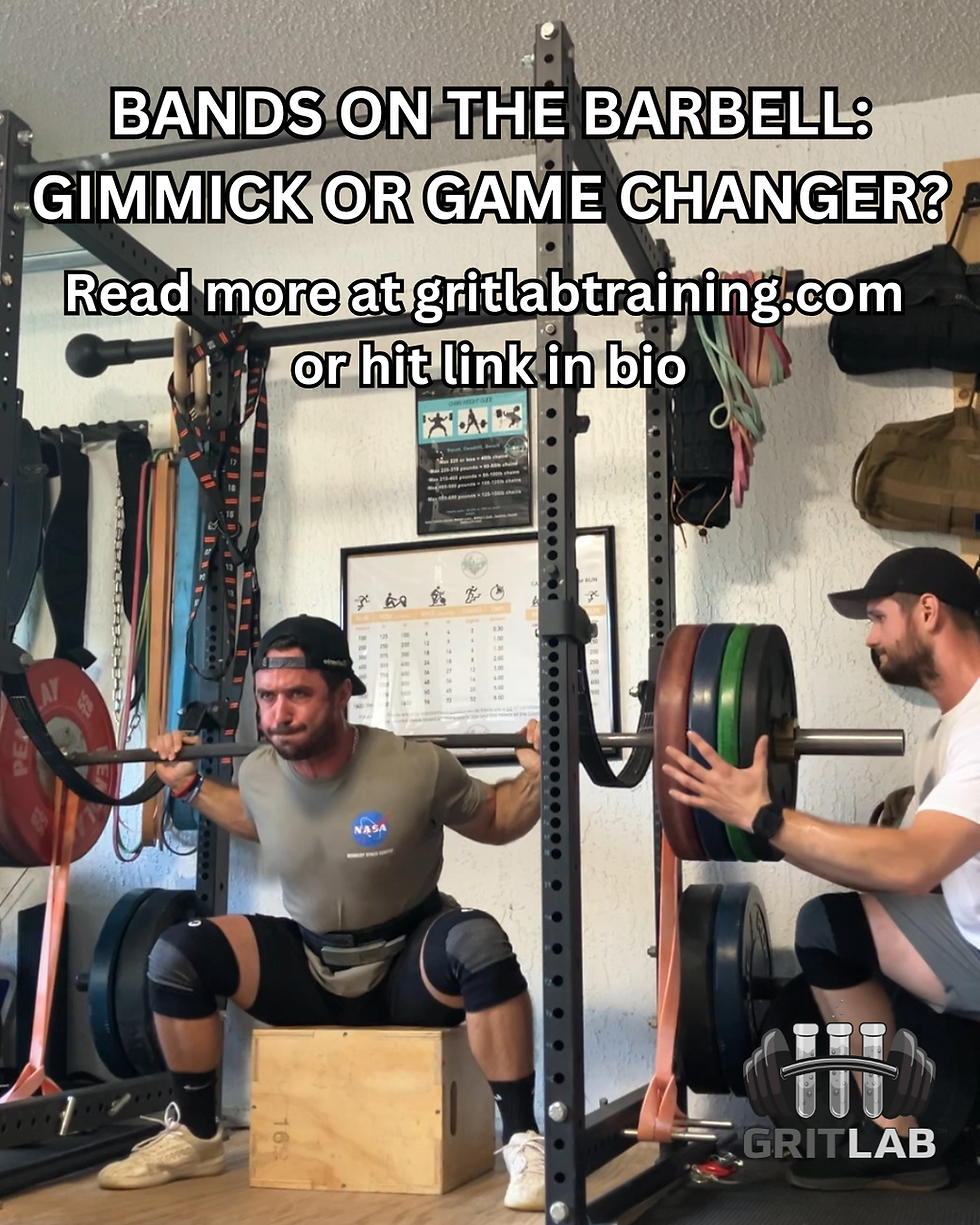
Band-assisted pull-ups allow you to train the exact movement pattern of a pull-up while reducing the amount of bodyweight you must lift. That matters because skill and strength develop together. The more quality reps you accumulate in the correct pattern, the faster your nervous system learns how to coordinate the movement. Instead of struggling through sloppy attempts, the band lets you perform controlled repetitions where your lats, upper back, and arms actually do the work. There is this incorrect notion that you can't get strong from banded pull-ups. This couldn't be farther from the truth. Banded pull-ups are just another form of accommodating resistance, similar to how you use bands or chains with barbell lifts, which we know works. Just look at the strongest lifters in the world at Westside Barbell.
The key here is progressive overload. Just like adding weight to a barbell, we gradually make the exercise harder by reducing assistance. You might begin with a thicker band that provides more support. Once you can complete all your sets in the target strength range of five reps, you decrease assistance by switching to a thinner band. Over time, less help from the band means more work from your muscles, and that is what drives strength adaptation.
The second drill is the negative pull-up, which targets another critical piece of the puzzle: eccentric strength. The eccentric phase is the lowering portion of the pull-up, and it’s an area where your muscles can handle significantly more load than during the lifting phase. Training this portion builds the raw strength necessary to eventually pull your full bodyweight.
To perform negatives, you start at the top position of the pull-up and lower yourself under control. This teaches you how to maintain tension through your lats, shoulders, and upper back while resisting gravity. Over time, we apply progressive overload here as well by adding external weight. Small increases, five to ten pounds at a time, make the lowering phase more demanding, strengthening the same muscles responsible for the pull.
Training twice per week strikes a productive balance. It provides enough frequency to practice the movement and build strength without overwhelming recovery. Each session reinforces the pattern, builds the necessary muscle, and moves you one step closer to your first full rep.
Beyond the primary pull-up drills, this program also uses a small amount of accessory work to build additional pulling volume. Exercises like dumbbell rows, inverted rows, and lat pull-downs strengthen the same muscles involved in the pull-up while allowing you to accumulate more total work. Think of these movements as the assistance lifts of your pull-up training.
Dumbbell rows help develop the lats and mid-back while also training the ability to stabilize the shoulder during a pulling movement. Inverted rows reinforce upper-back strength and body control while keeping the movement pattern very similar to a pull-up. Lat pull-downs provide another way to train vertical pulling strength, especially for beginners who still need more volume to build the necessary muscle.
These exercises are performed for moderate reps, usually around eight to twelve, to build muscle and reinforce the movement pattern without overly fatiguing the nervous system. That extra volume helps strengthen the lats, rhomboids, and biceps, which all contribute to a stronger pull.
For those who want a little more practice, the program also includes an optional third day using band-assisted chin-ups. Chin-ups use a supinated grip, meaning your palms face toward you. This grip places slightly more emphasis on the biceps and can often feel stronger and more natural for beginners. This adds variation to the program.
Using the same band progression as the pull-up day, chin-ups allow you to accumulate additional quality reps while strengthening the same muscles from a slightly different angle. This variation helps develop the arms and lats while continuing to reinforce the pulling pattern. Over time, that extra exposure can accelerate progress toward your first strict pull-up.
The bottom line is simple: apply progressive overload to the pull-up. When you train it with the same discipline you’d apply to a barbell lift, quality reps, structured progressions, and patience, you stop guessing and start building the strength required to earn that first pull-up.

Comments