
Bands on the Barbell: Gimmick or Game Changer?

Why GritLab Uses Bands for the Squat, Bench, and Deadlift
At GritLab, you’ll often see bands attached to the barbell on our Squat, Bench, and Deadlift sessions, especially on days where the focus is explosive strength and speed. This naturally raises a question: what role do the bands actually play, and why do we rely on them so heavily? To understand that, we need to start with the force-velocity curve.
The force-velocity curve demonstrates a simple but powerful concept: heavy loads move slowly but allow you to generate high amounts of force, while lighter loads move quickly but allow for far less force production. This aligns perfectly with the basic physics equation, Force = Mass × Acceleration. If you think about throwing a wiffle ball as hard as you can, it moves incredibly fast but doesn’t travel very far, because you cannot apply much force to something that light. A shot put, on the other hand, moves much slower but travels farther because the weight of the object lets you apply a tremendous amount of force to it. Somewhere between those two extremes sits a baseball. You can apply enough force and enough speed to throw it significantly farther than both. That “middle zone” is the sweet spot we target on Dynamic Effort days, moderate loads moved with maximal acceleration.
The challenge is that a barbell doesn’t behave like a baseball. During a Squat, Bench, or Deadlift, the bar begins at zero speed, accelerates through the mid-range, then naturally decelerates as you approach the top of the lift. On top of that, your leverage changes throughout the range of motion. The bottom of the lift is almost always the weakest position, while the top is typically the strongest. So, if the barbell is loaded heavy enough to challenge your weakest point, it becomes too light at the top. If it’s heavy enough for the top, it becomes overloaded at the bottom. In other words, the resistance profile of straight weight never truly matches the strength profile of the human body. This mismatch limits how much force and speed you can express through the entire lift.

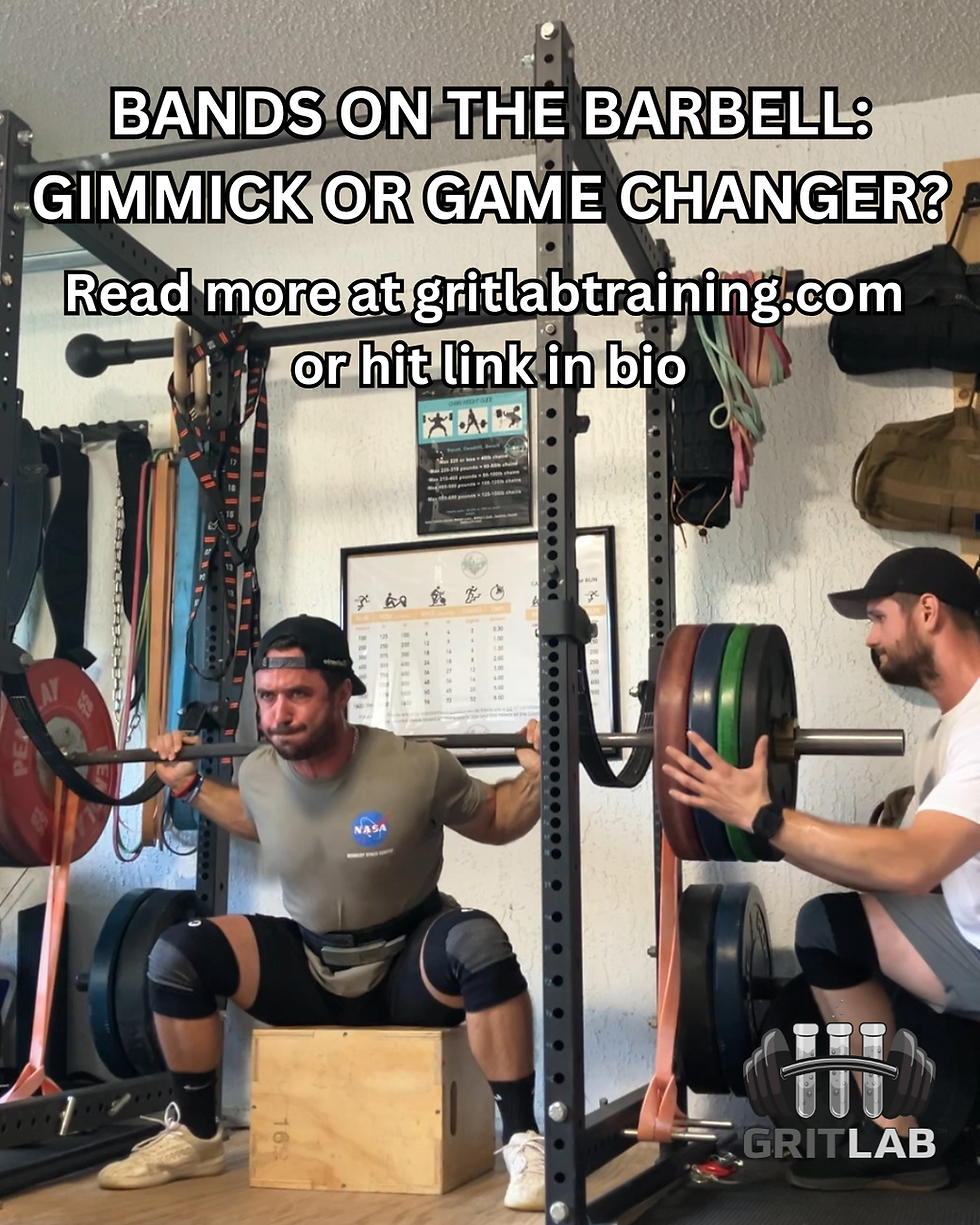
This is exactly where accommodating resistance, bands, changes the game. Their use in speed training was popularized by the great Louie Simmons of Westside Barbell, whose work was instrumental in brining Dynamic Effort Training and band tension into the strength world. Bands increase their tension as they stretch, which means the load gets heavier as you rise through the lift. At the bottom, where your leverage is poor, the band tension is minimal, allowing you to accelerate smoothly out of the hole. As you move toward the top and your leverage improves, the bands stretch and the tension increases, forcing you to keep driving and continue accelerating. Instead of coasting or slowing down near lockout, you’re pushed to maintain speed and force output through the entire range of motion. This trains the exact qualities we’re trying to build on Dynamic Effort day: explosive power, fast firing motor units, and the ability to apply force rapidly.
Another major benefit of bands is the effect they create on the eccentric portion of the lift. Bands pull you downward faster than gravity alone, creating what is called “over-speed eccentrics.” This quicker descent increases stored elastic energy and enhances the stretch reflex at the bottom. The real payoff is that you can reverse direction faster and produce more force out of the bottom compared to lifting straight weight. Over time, this translates to better bar speed, better power output, and stronger positions across all three lifts.
If you decide to integrate bands into your own training, the most effective place to use them is on your lighter Dynamic Effort Day. The typical approach is to use around twenty to twenty-five percent of your one-rep max as band tension and pair it with fifty to sixty percent of your one-rep max in barbell weight. For example, if your bench press max is one hundred pounds, you would use twenty to twenty-five pounds of band tension along with fifty to sixty pounds of bar weight. The goal is speed, so keep the reps in the one-to-five range. Once fatigue creeps in, bar speed drops, and when speed drops, the purpose of the session disappears.
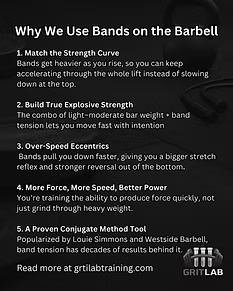
Bands allow us to train fast, stay explosive, and develop force production across the entire lift, not just at the bottom or the top. That’s why they’re a cornerstone of how we build explosive strength here at GritLab.
Want a program that utilizes bands in your training! Check out our online training programs

Comments